A cracked sidewalk is a safety issue, a liability, and in New York City it is your responsibility as the property owner. Here is how to handle small cracks yourself, when a slab needs replacing, and how to keep the work compliant.
Clean the crack out and fill it with a flexible concrete crack sealer. An afternoon of work, and it stops water getting into the base.
Chisel the crack into an inverted V, dampen it, then pack a high strength patching compound and level it flush with the slab.
Patching will not hold. The flag has to come out and be repoured to city thickness and slope, which is contractor work.
Concrete ages, but in New York it ages faster. Freeze and thaw cycles push the slab apart every winter, road salt eats at the surface, city tree roots lift flags from underneath, and delivery vehicles run over paths that were never poured for that weight.
Look cosmetic, but they let water into the base. That water freezes and turns one thin line into a broken flag.
Tree roots growing under the slab tilt it upward. This is the most common trip hazard on older blocks.
Surface flaking from salt and water. It spreads across the flag and weakens everything under it.
Slabs that have settled at different heights. Half an inch is enough to catch a shoe or a stroller wheel.
Broken corners where the sidewalk meets the curb or the apron, usually from vehicle weight.
Washed out soil beneath the slab. The concrete may be sound but the ground under it is not.
Catching these early is the whole game. A crack that gets sealed this season costs a fraction of a flag that has to be cut out next year, and an uneven sidewalk is a genuine liability if someone falls on it.
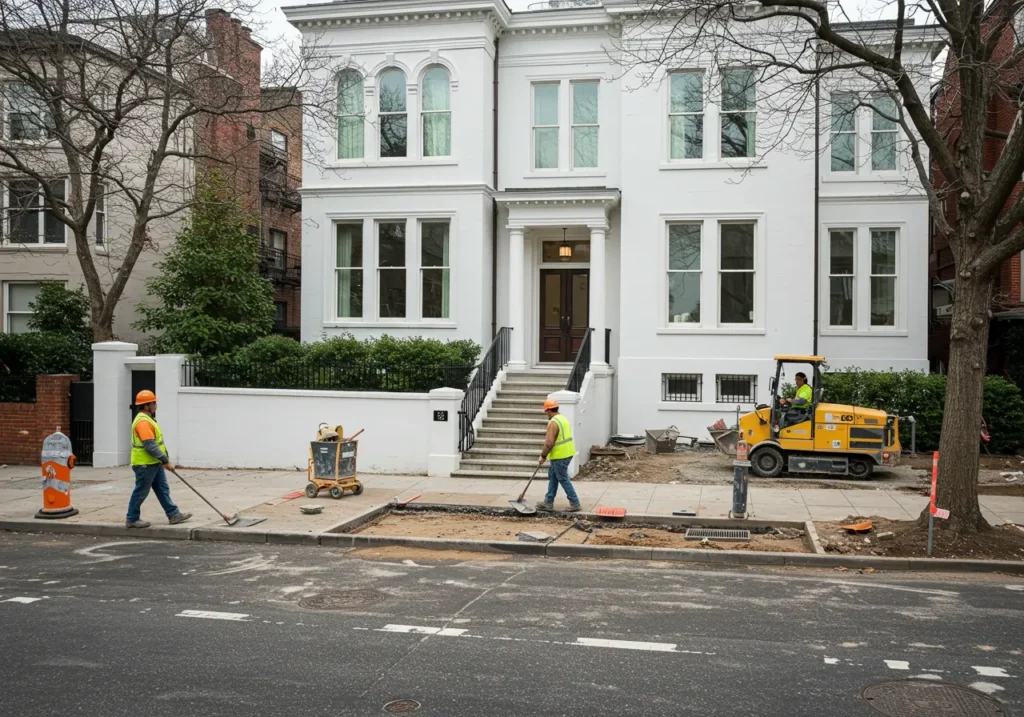
Wet cement burns skin, concrete dust damages lungs, and a half finished repair on a public walkway is a hazard to everyone passing by.
Heavy duty gloves. Wet cement is caustic and will burn bare skin.
Safety goggles while chiselling and brushing out debris.
A dust mask. Concrete dust carries silica, which you do not want in your lungs.
Cones or caution tape around the work area, since this is a public path.
Choosing the wrong product is the single most common reason a patch fails within a season. Narrow cracks need something flexible that moves with the slab. Deep voids need bonding strength.
Work out which one you have before you buy anything. The method for a hairline crack will not hold a broken slab together.
If a flag has broken into several pieces, tilted sharply, or been lifted by a tree root, no patch will hold it. The slab needs to come out, the base underneath needs fixing, and new concrete needs to be poured to the correct thickness and slope.
That is sidewalk repair and concrete replacement, and where roots are involved, trip hazard and tree root repair.
In most of the city, the sidewalk in front of your building is your responsibility to maintain, even when a city owned street tree caused the damage. If DOT inspects and finds defects, a violation notice goes to the owner, and it stays on the property record until the repair is done and re-inspected.
That changes the maths on a DIY repair. A sealed hairline crack is fine to handle yourself. Anything DOT would call a defect, such as a raised flag, a trip hazard or a broken slab, has to be repaired to city standards, and most replacement work needs a permit. Doing it yourself and failing the re-inspection costs more than doing it once properly.
If you already have a notice, start here: DOT sidewalk violation removal. If a street tree is the cause, read who pays for tree root sidewalk damage.
An afternoon plus cure time. Cost is the tools and a tube of sealer. Realistic for hairline and narrow cracks on your own property.
Half a day of work and 24 to 48 hours of curing before the path takes weight. Worth a contractor if the crack runs across the whole flag.
Several days once permits and scheduling are included. Costs more, but it fixes the base and clears a violation properly.
Whatever the level, respect the cure time. Concrete that gets walked on or driven over too early fails early, and then you pay for the same repair twice.
Sealing the concrete every two to three years is the single most effective thing you can do, because it keeps water out of the surface. After that it is all about water and roots.
Send us a photo of the sidewalk and we will tell you honestly whether it is a seal, a patch or a replacement. Free estimates across Manhattan, Brooklyn, Queens, the Bronx and Westchester.
Get a Free Estimate